There is a particular kind of silence at two thousand meters that no amount of insulation can manufacture. It arrives in the half hour before sunrise, when the wind drops and the snowpack on the north face has not yet started to move. It is the silence the new generation of alpine architects is trying to protect, rather than perform.
For most of the twentieth century, the architectural language of the high Alps was a fixed vocabulary: dark timber, steep pitched roof, low eaves, exterior shutters painted some defensible shade of red or green. The chalet was a costume the mountain wore for its visitors. It worked because the cliché was true — until, somewhere in the last decade, a small group of practices started asking what an alpine building should look like when it stopped trying to look like a chalet at all.
Material honesty above the treeline
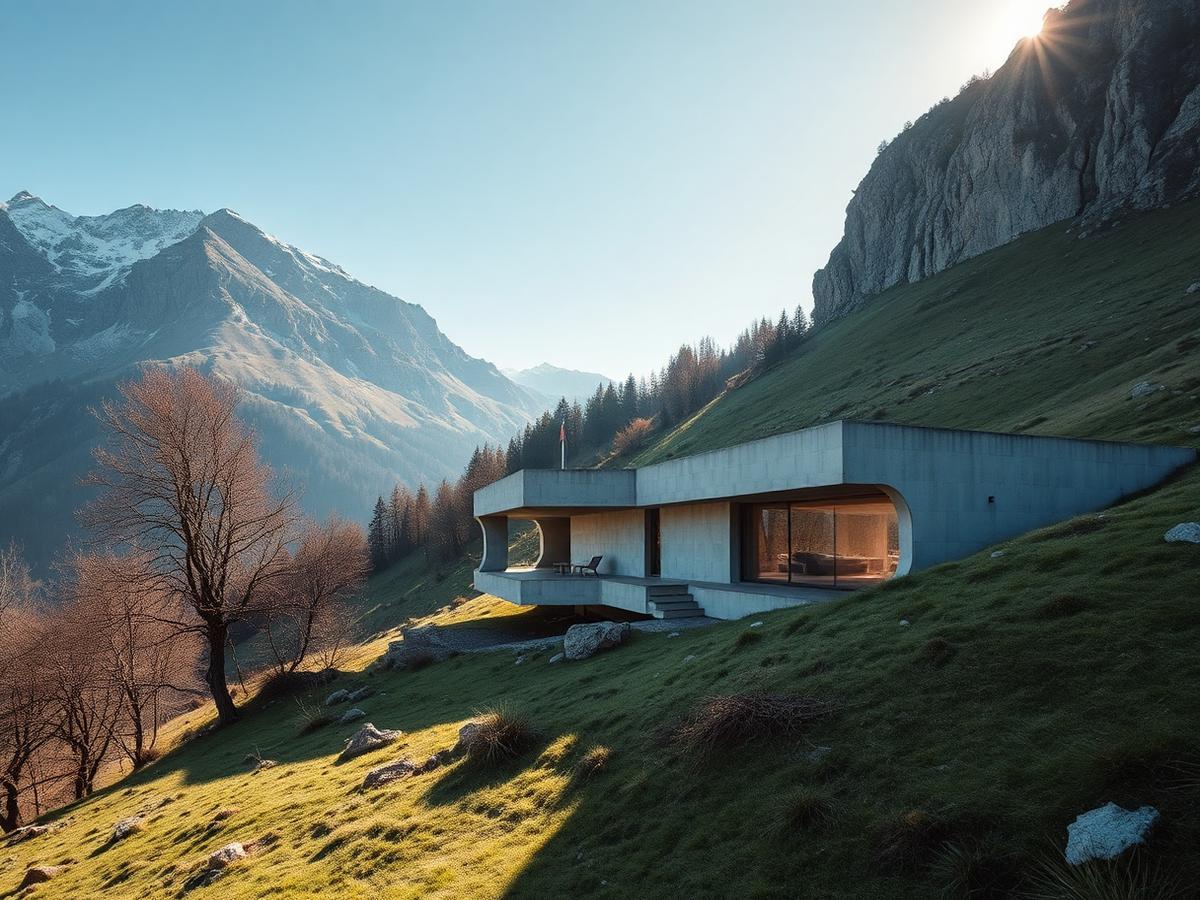
The project that brought me to the Engadin sits half buried in the slope above a working farm. From above, on the descent from the pass, you would not know it was there. From below, climbing the meadow, it reads as a single horizontal line cut cleanly into the grass. Inside, the only finishes are board-formed concrete, white oak, and glass. The kitchen is a slab. The bath is carved out of one continuous piece of stone.
Elena Vos, the architect, calls this material honesty. The mountain is not a backdrop, she says. It is a co-author. The building's job is to translate it. Concrete, in her reading, is closer to the stone of the surrounding peaks than any imported timber paneling could be. It weathers the same way. It holds light the same way. In time, it will carry the same stains of wet snow and lichen that the boulders outside have carried for centuries.
"If the building disappears, that is the highest compliment we can earn. Everything else is decoration."
— Elena Vos
The new vocabulary
Across Switzerland, Austria, and the Italian Alps, a roughly coherent set of moves is beginning to define this work. Buildings are pressed into the slope rather than perched on top of it. Roof lines are flat or barely pitched, which sheds snow more honestly than the picturesque steep pitch ever did. Windows are larger but fewer — one frame doing the work that twelve once did. Stone, concrete, and weathered larch are favored over the dark stained pine that defined the resort boom of the 1980s.
Inside, the same restraint applies. Furniture is low and few. The wood-burning stove is the only nostalgic gesture and is allowed precisely because it does something a heat pump cannot: it gives the room a center. The lighting is warm and almost always indirect. The acoustic environment is treated as carefully as the visual one — felt panels behind oak slats, soft fabrics, no hard echo.
A note on warmth
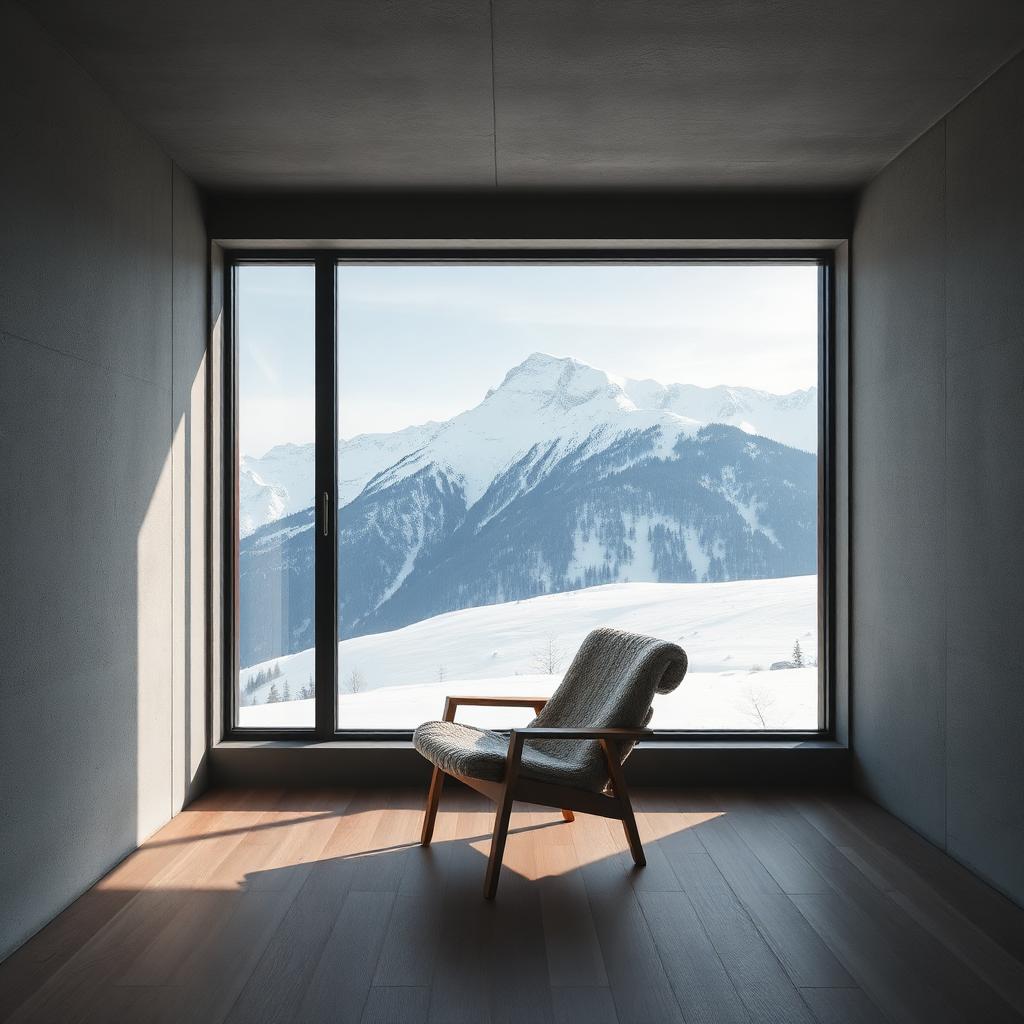
The most common critique of concrete in domestic architecture is that it is cold. Vos disagrees, and after a winter night in one of her buildings, so do I. Warmth, she argues, has very little to do with material and almost everything to do with light and proportion. A timber-clad room with a low ceiling and a small north window will feel colder than a concrete room with a south-facing window the size of a wall. The wool throw on the chair does the rest.
Building responsibly at altitude
There is a sustainability conversation underneath all of this that is harder to photograph but more important than the finishes. High-altitude construction is environmentally expensive: helicopters, fragile soils, long winters that shorten the build season, embodied carbon in the concrete itself. The architects doing serious work in the Alps today are increasingly explicit about the trade-offs.
- Use the slope. Earth-sheltered buildings need a fraction of the heating energy a freestanding cabin needs.
- Source within the valley. Stone, larch, and labor that travel less carry a smaller invisible cost.
- Design for a hundred-year life. The greenest building is the one that does not need to be replaced in twenty.
- Cap the floor area. A smaller sanctuary heated well outperforms a sprawling lodge heated poorly.
- Plan for the off-season. Buildings that stand empty for nine months a year are difficult to justify on any honest accounting.
What the alpine sanctuary asks of its guest
These buildings make demands. You cannot fill them with clutter without breaking the spell. You cannot turn the lights up to office brightness. You will, at some point in the first evening, feel slightly uncomfortable in the silence and reach for a phone. The discomfort passes. The mountain stays.
Spending a week in one of them changes how you read every other interior afterward. Hotel lobbies start to seem overdressed. Open-plan apartments at sea level feel busy in a way you had not previously noticed. You begin to suspect that the alpine sanctuary is not a typology for second homes but an argument about how all rooms might be designed if their designers had the courage.
Three buildings worth the detour
If you want to see this work without commissioning it, several practices in the Engadin, the Vorarlberg, and South Tyrol now operate small guest houses or open studios on request. A handful of public projects — chapels, refuges, mountain restaurants — apply the same vocabulary at a scale anyone with a hiking boot can visit. Plan a long weekend around two or three of them and you will have seen more contemporary alpine architecture than most magazines will cover in a year.
The view from inside one of these buildings, an hour before sunrise, is what stays with you. The concrete frame around the window is so quiet that, after a while, you forget it is there. What is left is the mountain — older than the building, older than the road, indifferent to either — and the small relief of being, for once, in a room that has the good sense not to compete with it.
Questions, answered
Frequently asked
Why concrete instead of wood in alpine architecture?
Material honesty: concrete weathers, holds light, and ages like the surrounding stone in a way imported timber paneling cannot. It is closer to the mountain than the chalet vocabulary it replaces.
Is concrete a sustainable choice at altitude?
Only when paired with restraint — earth-sheltered footprints, locally sourced aggregate, smaller floor areas, and a hundred-year design life. The greenest alpine building is the one that does not need to be replaced in twenty years.
Where can I visit examples of this architecture without staying in one?
Several practices in the Engadin, Vorarlberg, and South Tyrol open small guest houses on request. A handful of chapels, refuges, and mountain restaurants apply the same vocabulary at a scale anyone with a hiking boot can visit.
Conversation
Be the first to comment
Comments are reviewed automatically before they appear. Please keep it respectful.
Loading comments…